Every missed call is a customer who called someone else next
A caller who cannot reach you often does not try twice. They scroll one line further down the search results and dial the next number. This guide covers the five places calls actually go missing, the mechanics that recover them, and how to measure the loss honestly instead of guessing.
22 July 2026 · 8 min read
The call you never saw
Picture 12:40 on a Tuesday. Reception is at lunch, the two people who normally pick up are on other lines, and the phone rings out. A facilities manager with a signed budget hangs up after twenty seconds, goes back to the search results, and dials the company listed below yours.
Nothing about that moment appears anywhere in your business. Your accounts show the invoices you raised. Your pipeline shows the deals someone typed in. The one thing that never gets recorded is the enquiry that arrived and left again, because no system was watching the phone closely enough to notice.
That is the uncomfortable part of missed calls business owners tend to underrate: the loss is invisible by construction. You do not feel it as a bad month, you feel it as a quiet one. And because there is no evidence, the conversation at the end of the quarter is about marketing spend rather than about the twenty seconds of ringing that decided the outcome.
The good news is that almost none of this requires hiring. It requires the phone system to behave differently when nobody can answer.
Where calls actually go missing
When a team looks properly at its own unanswered calls, the losses tend to cluster in the same five places:
- Outside working hours. Evenings, Fridays and public holidays, when the caller gets a ring tone that goes nowhere and no way to leave a trace behind.
- The lunch and prayer-break dip. A one-hour hole in the middle of the day, every day, in a business that is otherwise fully staffed.
- Everyone genuinely busy. Three enquiries land in the same four minutes. The first is answered, the second waits, the third leaves.
- The single owner of the number. One person's mobile is on the website. When they are driving or in a meeting, the company is closed.
- The transfer that dies. The caller reached you, was passed to a colleague, and the colleague's phone rang out. This one hurts most, because they had already invested effort in you.
Each of these has a different mechanical fix, and none of them is "answer faster". Trying harder is not a system. What follows are the four mechanisms that do the work, all part of the smart call centre with queues, IVR and recording, plus the reporting that tells you whether they are working.
Queue callback: keep their place in line
Hold music is a test of patience that most callers fail. They are not comparing you against a competitor at that moment, they are comparing you against hanging up, and hanging up always wins eventually.
Queue callback removes the test. Once a caller has been waiting past a threshold you set, the system offers to keep their position and ring them back when an agent frees up. They hang up without losing anything. When their turn arrives, the platform dials them, and only connects them to a person once the caller has actually picked up, so nobody spends their turn listening to a ring tone.
The behavioural effect is larger than the mechanical one. A caller who accepted a callback has an appointment with you. A caller who abandoned in a queue has a grievance, and often a competitor's number already dialled.
Set the threshold based on your own answer times rather than an arbitrary number. If your queue almost never exceeds thirty seconds, offering callback at ten seconds trains people to opt out of a conversation they would have had anyway.
After-hours flows that respect the caller
Most after-hours handling is a recorded sentence telling the caller they should have called earlier. That is a wasted opportunity, because the caller's intent is at its peak right then.
A proper flow branches on what the caller needs. An existing customer with a fault should reach an on-call number or leave a message that becomes a ticket. A new enquiry should be captured with a number to call, and ideally offered a callback slot for the next morning. A routine question about opening times or location should simply be answered by the recording, because that call never needed a person at all.
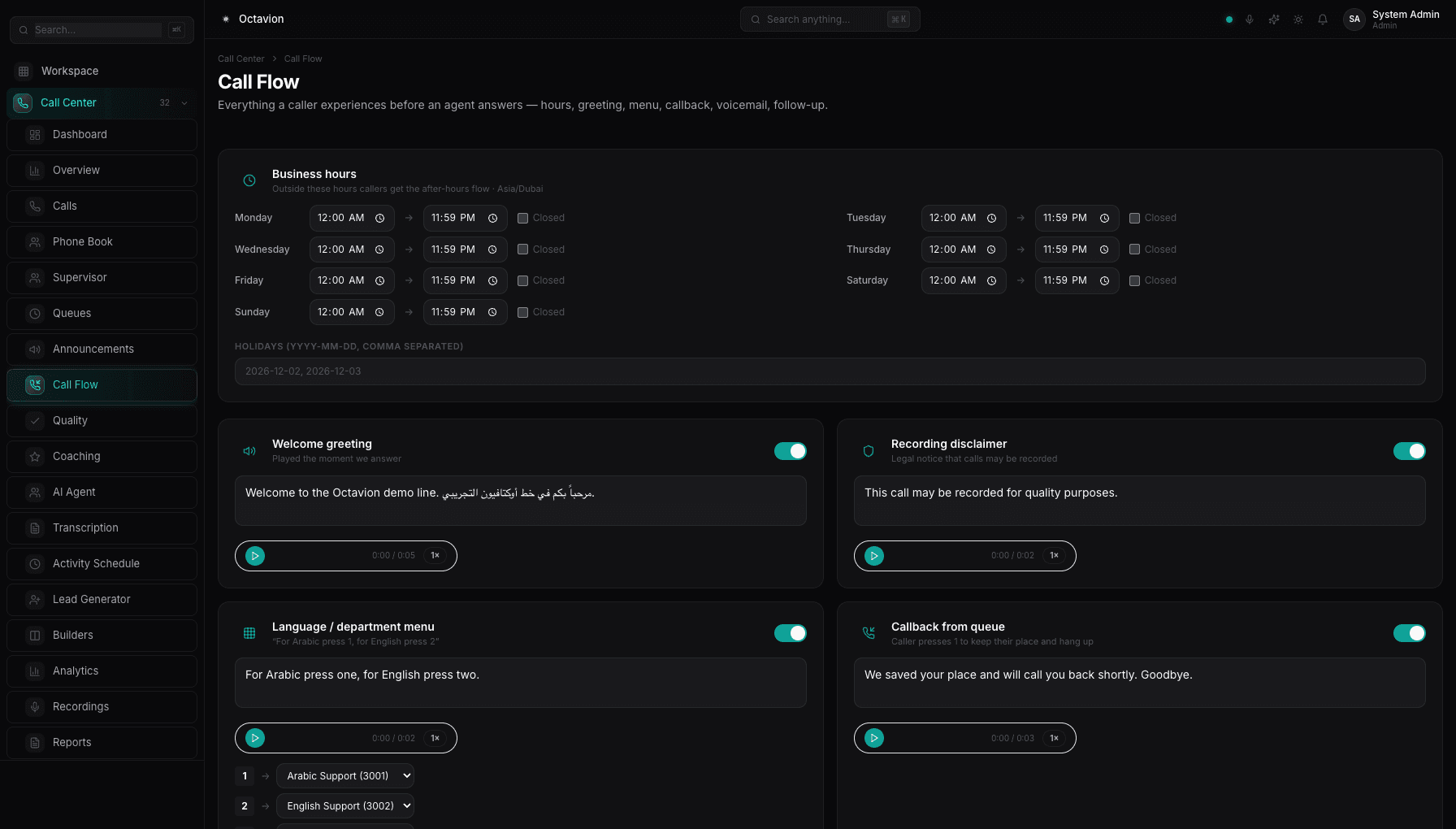
Building that used to mean a support ticket and a week's wait. The no-code call flow designer lets an operations manager drag the branches into place, check them against a working-hours and holiday calendar, and publish. You can see the whole design surface alongside the rest of the telephony tooling on the platform feature overview, and the step-by-step configuration lives in the product documentation.
Two details are worth getting right. Record the greeting in Arabic and English rather than assuming one language, and make sure the flow announces the number the caller has actually reached, so a wrongly dialled digit does not turn into a silent voicemail nobody can action.
Voicemail that reaches a human inbox
Traditional voicemail fails for an unglamorous reason: it sits in a box that requires a password, a handset and a habit. Messages are heard on Sunday morning that arrived on Thursday evening.
Voicemail-to-email removes the retrieval step. The recording arrives as an email attachment with the caller's number, the time and the queue it came from, so it lands in the same place the rest of the team's work lands. Where AI transcription is switched on, the message arrives as text as well, which means it can be read in a meeting, forwarded to the right colleague, and searched three months later.
Route messages to a shared address rather than an individual. A voicemail sent to one person is a single point of failure with a holiday calendar. For anything that carries a promised response time, push the message into the helpdesk with SLA timers and a customer portal instead, so the clock starts automatically rather than depending on someone remembering.
WhatsApp as the second attempt
A missed call is a signal, not a dead end. Somebody wanted you enough to dial. The question is only which channel gets the second attempt, and in the UAE the honest answer is usually WhatsApp.
A short message sent within minutes of an unanswered call often recovers the conversation without either side dialling again. Acknowledge the call, name the business, offer a time. It also gives the customer a written thread they can reply to at their own convenience, which matters when the person you need is in a workshop or a clinic.
Do this on WhatsApp through the official Meta Business Platform rather than someone's personal handset. The distinction is not pedantry: personal numbers take the conversation with them when the employee leaves, and they leave no record anywhere. For website visitors who never reach the phone at all, live chat on your own site catches the same intent one step earlier.
Measuring what you are losing
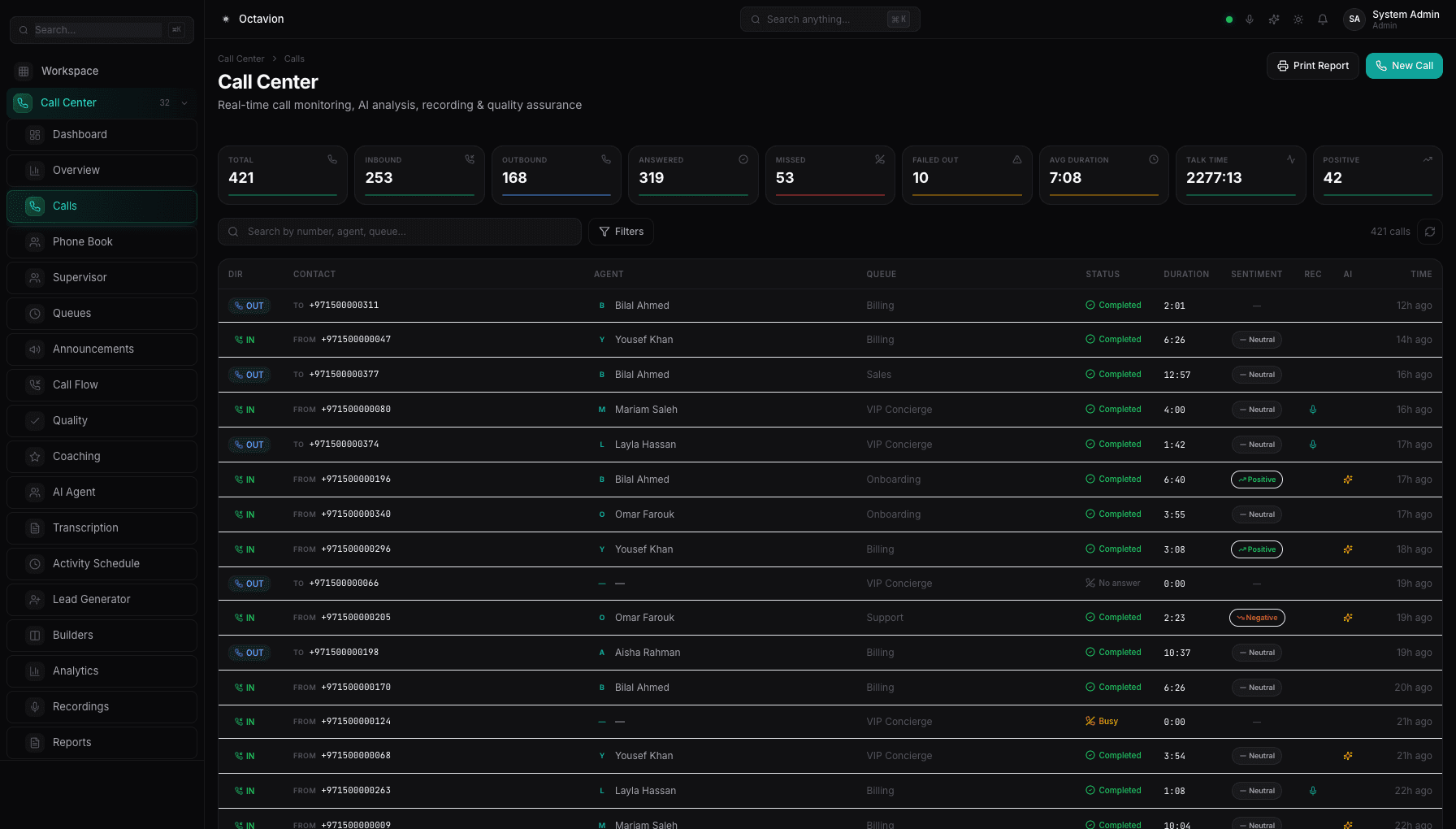
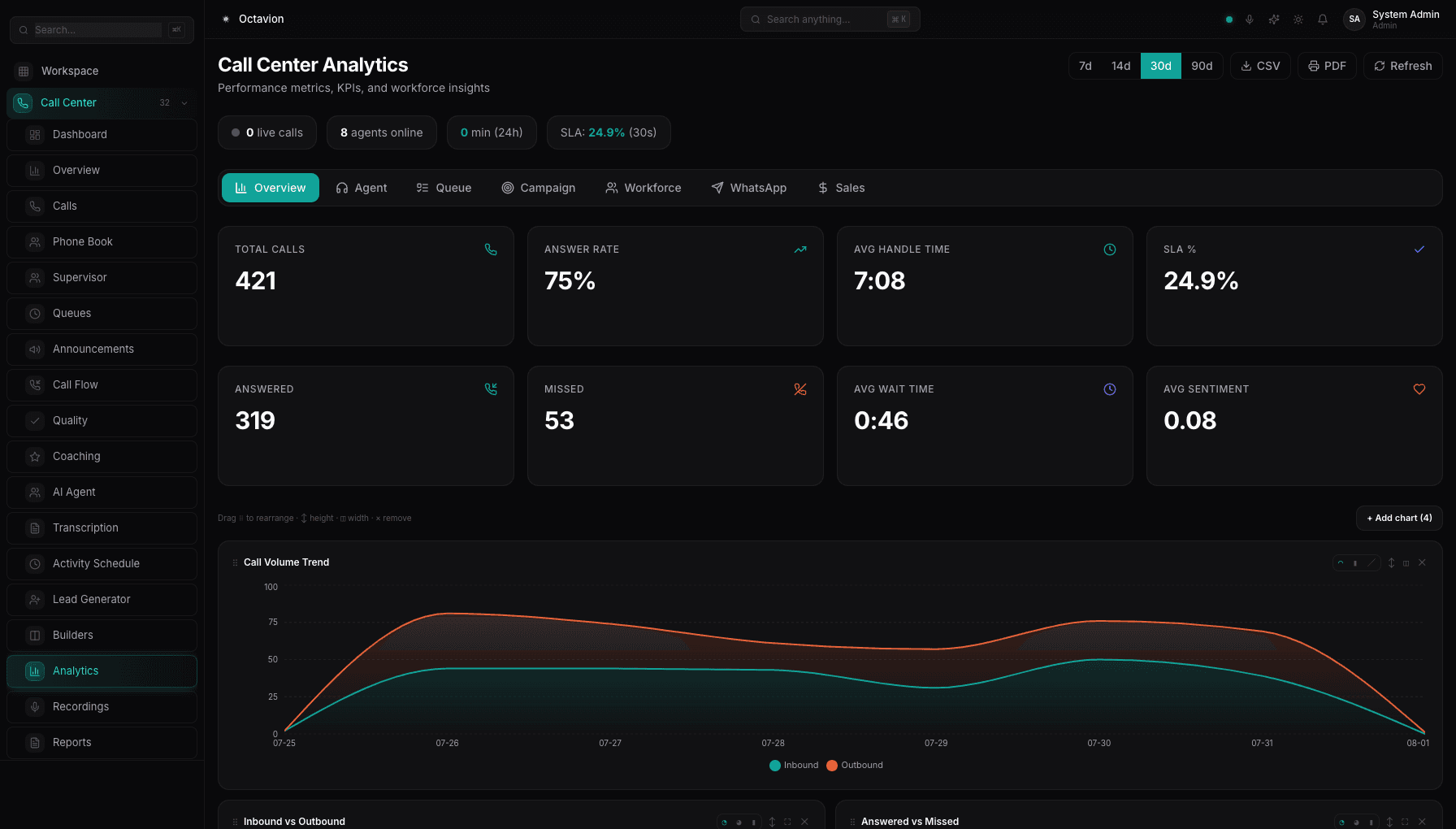
Most phone reporting flatters whoever runs the phones. The single most common distortion is a "missed" count that quietly includes outbound attempts the network rejected, calls that rang a second desk after being answered on the first, and internal transfers. Fix the definitions before you draw any conclusions, because a number that cannot be trusted is worse than no number.
Four measures carry most of the weight:
- Answer rate by hour and weekday, which is where the lunch dip and the Friday hole become undeniable.
- Abandoned in queue, counted separately from calls that rang with nobody logged in, because the two have different cures.
- Callback completion: how many offered callbacks were accepted, and how many of those actually reached the customer.
- Out-of-hours volume, which tells you whether an evening shift would pay for itself or whether a good flow is enough.
Put a value on the average enquiry and the arithmetic stops being abstract. Take the average first order value your own accounting already shows, multiply it by the unanswered enquiries in the report, and you have a figure you can defend in a management meeting. That figure has to come from your books rather than an industry guess, which is one reason the phone and the accounting and stock side of the platform belong in the same system. If you are still assembling that financial picture, our guide to what a VAT-ready ERP has to do in the UAE covers the ground.
Making the callback someone's actual job
Every mechanism above ends the same way: a person owes a customer a call back. That is where recovery programmes usually collapse, because the obligation lives in an inbox instead of a queue with an owner.
The fix is to treat a missed call as a work item. It should appear on a list, carry a name, and be closed with an outcome. In the CRM with real click-to-call and automatic call logging, returning the call is a single click from the record, and the call, its recording and its AI summary attach themselves to the customer timeline without anyone typing notes. Nobody has to be disciplined for the record to exist.
Supervisors get the other half of the picture: live monitoring, listen, whisper and barge on calls in progress, and sentiment on completed ones. And the voice-first AI assistant in Arabic and English can read the day's call data and create records directly, so the review does not depend on someone building a spreadsheet.
The shape of the problem also differs sharply by sector. A clinic missing appointment requests behaves nothing like a trading company missing quote enquiries, so the industry breakdowns are the better starting point for deciding which mechanism to build first.
If you want to know what this is costing you, the fastest honest answer is a fortnight of real measurement. Sign up for the 7-day trial, point one number at a queue with callback and an after-hours flow, and read the answer-rate report at the end. It is sold per seat per month in AED, so start with the people who actually answer the phone and add more only when the numbers justify it. Per-seat pricing is published, and the questions buyers ask most covers what setup involves before you commit.