The hidden cost of eleven subscriptions
Nobody plans to run eleven subscriptions. Each one solved a real problem on the day it was bought, and together they now cost more in human attention than they ever did in dirhams. This is a guide to pricing that hidden cost honestly, and to deciding when consolidating is genuinely worth the disruption.
25 July 2026 · 8 min read
On this page
The eleventh subscription
Nobody sets out to run eleven tools. You bought the accounting package because the auditor asked for one. The pipeline spreadsheet became a CRM the month it started fighting back. Support moved to a shared inbox, then to a ticketing tool, because customers kept replying to the wrong thread. Somewhere in there a standalone dialler appeared, because until then the phone system was three mobile numbers and a lot of goodwill.
The problem is not any single tool. It is the eleventh one, and the fact that the real cost of the stack no longer shows up on the card statement.
Total the subscriptions and you get a manageable number. Total the hours your team spends moving data between them, checking that it moved, and arguing about which copy is right, and you get a very different one. That second number is what this guide is about.
The integration tax nobody quotes
Integration is sold as a one-off project. It behaves like rent.
The first version is genuinely quick. A connector service picks up new contacts from one system and creates them in another, someone maps the fields on a Thursday afternoon, and it works. What is not quoted is everything after that. Field mappings drift when one vendor renames a property. Rate limits throttle a busy morning and the queue silently backs up. A required field is added on one side and every sync fails until someone notices, usually a customer, usually in a complaint.
Then there is ownership. Connectors are almost never owned; they are inherited from whoever built them, and when that person leaves the business discovers it has a load-bearing automation nobody can explain. The documentation, if it exists, is a screenshot in a chat thread from two years ago.
The tax is also paid in latency. A deal marked won at 11am becomes an invoice at 11:20 if the sync is on a twenty-minute cycle, or the next morning if it is nightly. In between, two teams look at two versions of reality and both are confident.
Worse, fragile connectors teach people to keep private copies. A manager's own spreadsheet of the real pipeline is a rational response to an unreliable sync, and it makes the next reconciliation harder still.
The customer record that exists in four places
Pick one customer and count the copies. There is a contact in accounting, carrying the trade licence name, the TRN and the payment terms. There is a lead or account in the CRM, carrying the trading name everyone actually uses and the notes from the last three meetings. There is a requester in the helpdesk, identified by whichever email address they happened to write from. And there is a caller ID entry in the phone system, if anyone bothered to save the number.
None of these are wrong. They are just four partial truths, each maintained by a different team, each with a different idea of what a customer is.
The consequences are quiet rather than dramatic. An invoice goes out to the old address because only the CRM was updated. A support agent apologises for a delay to a client whose account has been on stop for three weeks, because the helpdesk has no idea about credit status. A sales person calls a number that was disconnected in March. Nobody is negligent; the information simply never travelled.
The deeper cost is that reporting becomes a negotiation. Ask how many active customers you have and you get three answers and a meeting.

Who becomes the human API
Every split stack eventually appoints someone to hold it together. It is rarely a formal appointment.
It is usually the operations person or the office manager, often the most capable administrator in the business, and their job quietly becomes reconciliation. They export a list on Sunday evening and import it on Monday morning. They retype the deal into the accounting system because the connector only handles contacts, not line items. They chase the sales person for the outcome of a call that the dialler recorded but nothing else knows about. They are, in effect, the integration layer.
This never appears in a software budget. It is a salaried person spending a share of their week producing no new value, only consistency. It is also fragile: when they take leave, the numbers stop being trustworthy, and everyone learns how much the business depended on an undocumented routine in one person's head.
Price it before you dismiss it. If you honestly estimate the hours per week spent on re-entry, reconciliation and chasing, multiply by a loaded hourly cost, and annualise it, the figure is usually a large multiple of the subscription total. That comparison, not the licence fees, decides whether consolidating makes sense.
The person doing this work is usually the one you would most want improving collections or handling your best accounts. Every hour they spend as a bridge is judgement the business paid for and did not use.
What one platform actually buys you
The argument for one platform instead of many separate tools is not that a single vendor is inherently better at everything. It is that the customer record stops being copied, because there is only one of it.
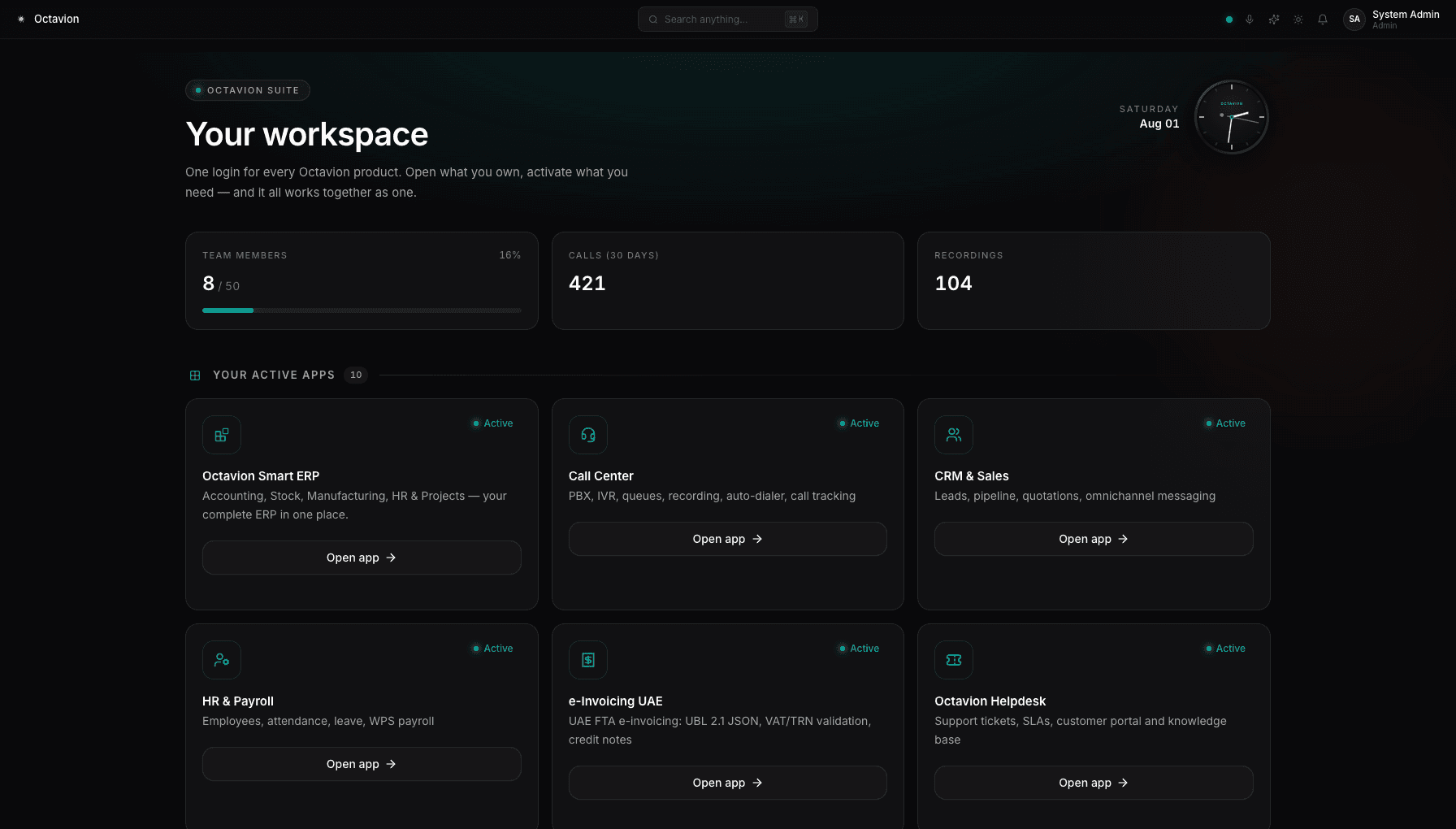
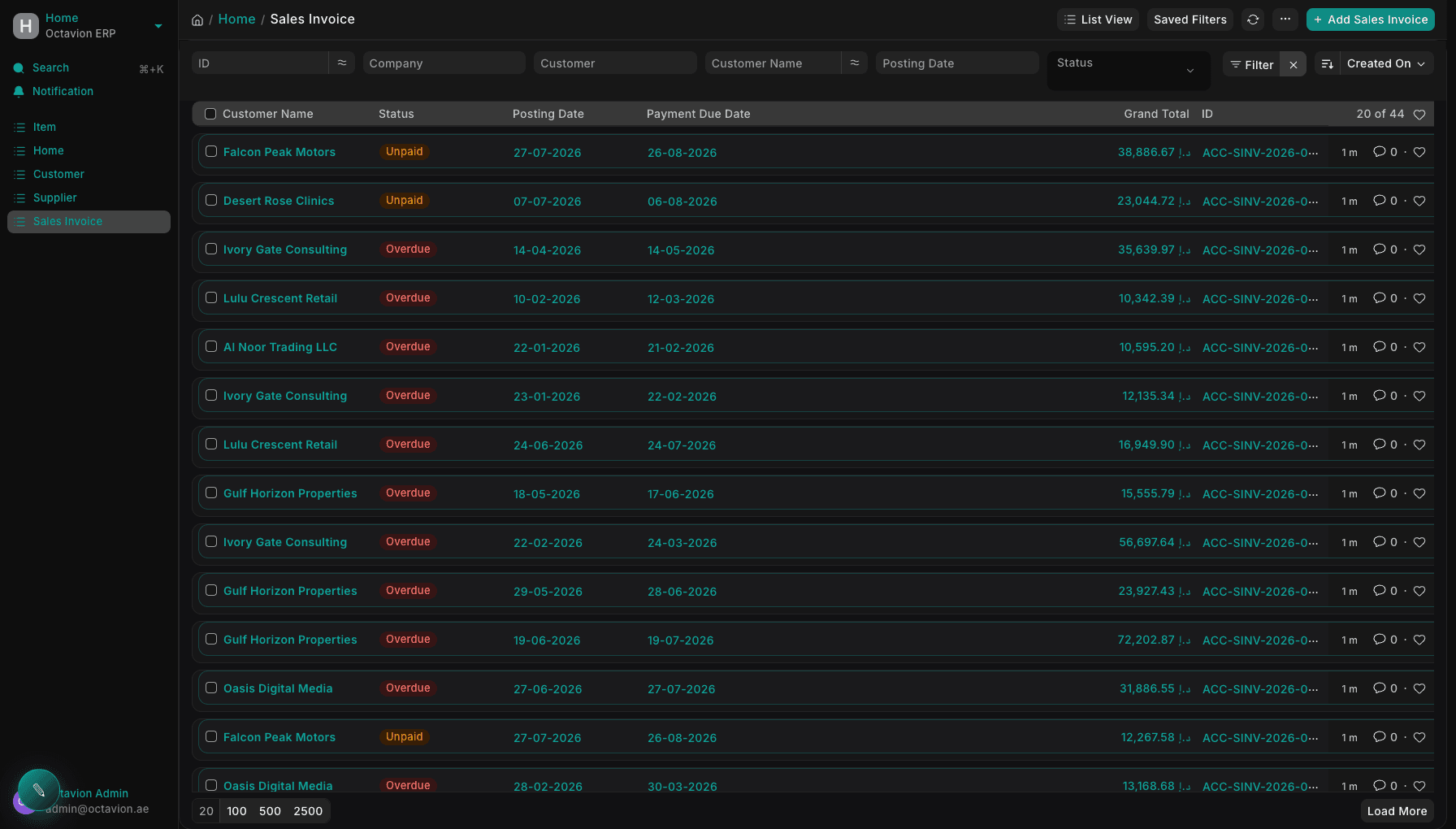
What changes in practice is narrow and specific. A sales person clicks a number in the pipeline, their headset rings, the customer is connected, and the call is written to the customer's timeline with its recording, transcript and summary. Nobody logs anything, because there is nothing to log. A won deal becomes a quotation and then an invoice against the same account that support is looking at. A ticket raised by that customer shows the person answering it what they have bought and what they owe.
That is the whole mechanism: shared identity. Everything else follows from it. The accounting, AED invoicing and multi-warehouse stock side works from the same customer as the CRM with real click-to-call and automatic call logging, which works from the same customer as the call centre with queues, recording and AI transcription. Add SLA timers and a customer portal in the helpdesk, WPS-ready HR and payroll, WhatsApp on the official Meta Business Platform or email campaigns drawn from the same contact list, and none of them need a connector to know who they are talking about.
It also makes assistance possible rather than decorative. A voice-first assistant that reads live business data in Arabic or English is only useful when there is one dataset to read; across eleven tools it can do little more than guess.
When staying split is the right answer
Consolidation is not automatically correct, and anyone selling it should say so.
If one of your tools is genuinely specialist, a compliance system for a regulated activity, a design or engineering application, something with depth that a general platform will not match, keep it. The right shape is often a consolidated core with one or two deliberate satellites, not a monoculture.
If you are a team of three and the whole stack fits in two applications, the integration tax is small and the effort belongs with customers instead. If you signed an annual contract six weeks ago, waiting for the renewal date is simply cheaper. And if you are in the middle of a merger, an audit or a peak trading season, the time to migrate is after it, not during.
The honest test is whether the pain is structural or seasonal. A bad quarter of manual work caused by one broken connector is a repair job. Four copies of every customer is structural, and it will not improve on its own.
How to judge whether consolidating is worth it
Rather than compare feature lists, answer six questions with numbers you can defend:
- How many hours a week does your team spend re-entering or reconciling data between systems, and what does that cost annually?
- How many separate places would you have to update if a customer changed their name, address or TRN tomorrow?
- When a connector fails, how long is it before someone notices, and who is that someone?
- Can you answer what a customer is worth, what they owe and what they have complained about in one screen, or does it take three logins?
- Which tools are actually load-bearing, and which are still being paid for out of habit?
- What is the real switching cost: data extraction, retraining, parallel running, and the month of reduced output?
If the annual cost of the answers to the first four exceeds the one-off cost in the sixth, consolidation pays back inside a year. If it does not, stay where you are and fix the worst connector instead. Compare the arithmetic against per-seat pricing in AED rather than against a hypothetical, and look at the full list of applications to see how much of the current stack a single platform would actually absorb.
One caution specific to the UAE: whatever you choose has to handle 5% VAT properly, not as an afterthought. If that is your main driver, read what a VAT-ready ERP actually has to do in the UAE before you evaluate anything.
A migration that survives month-end
Most consolidations fail on sequencing, not on software. The instinct is to move everything in one weekend; the result is a finance team locked out during a close.
A safer order looks like this:
- Move customer and supplier master data first, settling which copy is authoritative before anything is imported.
- Run the new system alongside the old one for one full cycle, one month of invoices and one month of tickets, and compare the totals.
- Cut over the transactional work only after the numbers match, then decommission the old subscriptions deliberately rather than letting them lapse.
Two practical notes. Keep the old system readable for the statutory retention period even after you stop paying to write to it. And do not migrate the mess: a consolidation is your one honest opportunity to delete the duplicate contacts, the dead leads and the products nobody has sold in years.
If you want to test the premise rather than argue about it, the experiment is small. Put one team and one real workflow on a single platform for a week, a deal that becomes an invoice, a call that logs itself, a ticket raised against the same account, and see whether anyone still needs to retype anything. The trial runs for 7 days and is charged per seat per month in AED afterwards. Octavion hosts the platform, so there is nothing for your team to install.
You can start the 7-day trial and try that one workflow, or check what the seats would cost before you commit a single hour to migration planning.