Choosing call centre software in Dubai
Your team is not lazy and your phone line is not broken. Most missed-call problems come down to calls arriving somewhere that was never built to hold them. This is a practical guide to what actually matters before you sign anything.
30 July 2026 · 8 min read
On this page
- 01Where your missed calls are actually going
- 02A dialler is not a call centre
- 03Local numbers, SIP trunks and the boring plumbing
- 04Queues, routing and a call flow you can change yourself
- 05Recording, transcription and what you do with the audio
- 06Supervision: listen, whisper, barge — and the scorecard
- 07The numbers that tell you whether it is working
- 08What to check before you sign
Where your missed calls are actually going
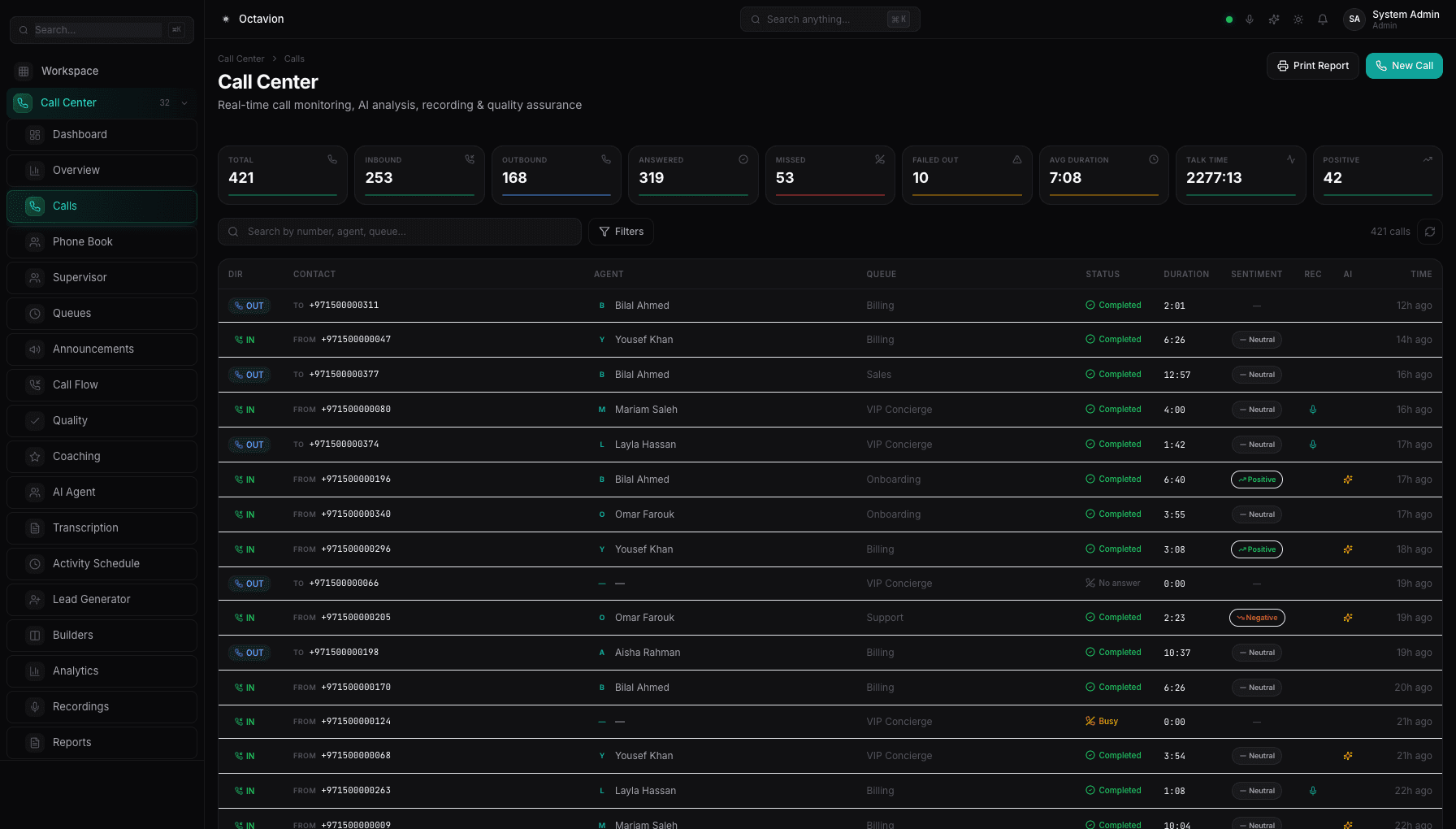
Before you shortlist a vendor, spend a week counting. Not estimating — counting. Ask whoever holds the phone contract for a call detail report and read three columns: calls that arrived, calls that were answered, and how long the rest rang before the caller gave up.
Three patterns show up again and again in Dubai offices. The first is a single line diverted to a mobile: one caller gets served, everyone else hears an engaged tone, and an engaged tone leaves no trace. The second is the rota of personal mobiles, where a call rings for thirty seconds then drops into a voicemail box nobody has the password for. The third is the hour after five, when calls arrive and nothing tells the caller when to try again.
None of these is an agent performance problem, and none is solved by a faster way to dial out. They share one structural gap: there is nowhere for a call to wait. A queue turns a lost call into a delayed one. Without it, hiring another agent only spreads the same losses more thinly. Count first — the number is usually worse than the feeling.
A dialler is not a call centre
Most searches for call center software in Dubai end up on a sales tool with a dial button attached. Pressing it places an outbound call and writes a line in an activity log. That is genuinely useful, and it is a small share of the job.
Answering is the harder half. It needs somewhere for the caller to sit, an announcement so they know they have not been forgotten, a rule that decides which agent gets the call, an overflow when nobody is free, an out-of-hours path, a recording, a supervisor who can intervene mid-call, and a record that outlives the agent.
Click-to-call still matters, and it should be real: your headset rings first, the customer's phone rings second, and the call attaches itself to the customer record without anyone typing. That is how click-to-call inside the leads and deals pipeline behaves. But it sits on top of a telephony platform and is no substitute for one. If your problem is inbound, a better outbound button changes nothing.
The honest test: ask a vendor what happens to the fourth caller when three agents are busy. If the answer involves the word "voicemail", you are being sold a dialler. A proper call centre platform with queues, IVR and recording answers with a queue position and a wait treatment.
Local numbers, SIP trunks and the boring plumbing
Any call center software you run in Dubai eventually terminates on a licensed UAE operator's trunk. Nobody demos this part, and it is the part that breaks.
Ask four questions early. Can I keep my published number, or am I quietly being moved to a new one? Who holds the trunk contract — you, or the vendor? How many concurrent channels am I paying for, since that is the real ceiling on callers served at once? And is each incoming number mapped to a queue, or to one person's extension?
Then the technical traps. Codec negotiation is common: a browser phone may prefer a codec the operator's trunk refuses, and the call fails with an error nobody in the office can read. Number formatting is another: a UAE mobile written as 05x locally and in full international form on the trunk is one phone to a human and two to software. Get it wrong and outbound calls fail, or names never match your phone book.
A third trap surfaces weeks in. Every published number must be mapped explicitly to the account it belongs to, or reports will attribute calls to the wrong place. And ask what happens when the trunk deregisters at three in the morning: the right answer is an alert, the common one is that you hear it from a customer.
Queues, routing and a call flow you can change yourself
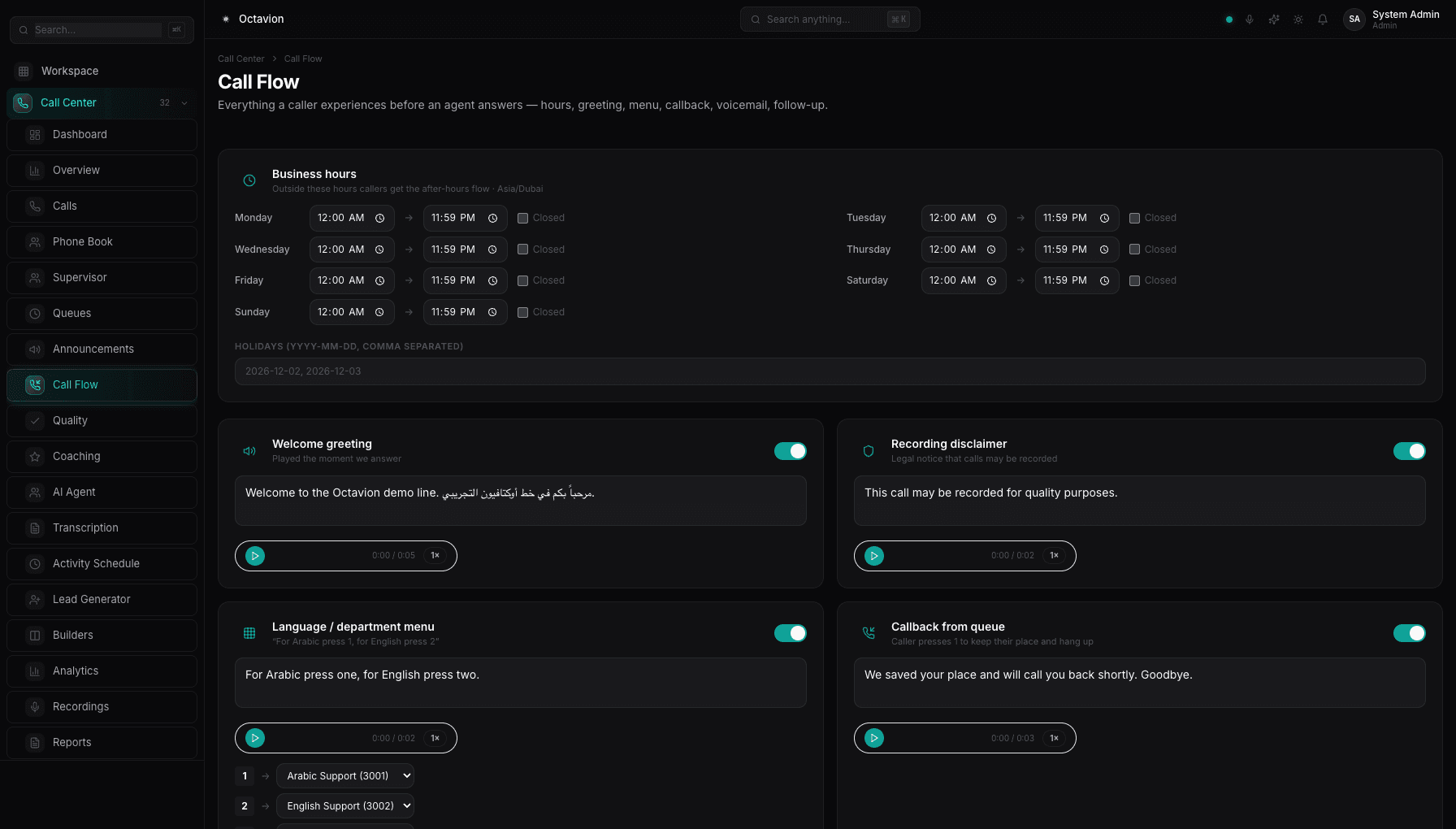
A call flow is the decision tree a caller walks through before a human speaks. Working hours first, then a greeting, then a menu if you need one, then the queue with a rule for who receives the call — longest idle, priority, or skill. Then the exits: a callback, a voicemail that arrives as email, an overflow to a second team.
Those exits deserve design, not defaults. A callback should hold the caller's place and ring them back; a voicemail that lands in an inbox with the audio attached gets returned, one behind a four-digit code does not.
The question that separates products is who may change any of it. If adjusting your opening hours during Ramadan requires a support ticket and a three-day wait, the flow goes stale and your team routes around it. A no-code designer lets an operations manager move a box, save, and hear the difference on the next call. Prompts should exist in Arabic and English, because half your callers will choose each.
Escalation deserves its own thought. A call that becomes a complaint should not die as a note in someone's notebook — it should become a ticket with a clock on it, which is what helpdesk tickets with SLA timers and a customer portal are for. The same applies to channels that are not voice: WhatsApp on the official Meta Business Platform and live chat on your own website absorb a surprising share of the enquiries now arriving as calls you cannot answer.
Recording, transcription and what you do with the audio
Every vendor records calls; almost nobody listens. An archive no one opens is a storage bill with a compliance flavour.
What makes recordings useful is what happens automatically after the call ends: a transcript you can search by word, a summary of what was agreed, a sentiment read that flags the conversation which went badly, and a one-click path to push all of it onto the customer's timeline, so the next person starts informed. That is the difference between an archive and a memory.
Two practical notes. Keep a recording announcement in the flow — telling callers they are recorded belongs in the greeting, not the small print. And insist on disposition codes drawn from a list your business actually uses. A clinic needs "appointment booked"; a trading desk needs "price too high" and "item out of stock". Those codes let you later say why calls were lost, instead of saying the phones were busy.
If you want transcripts to do more than sit there, the voice-first AI assistant that reads live business data answers questions across them in Arabic or English, and creates records rather than describing them.
Supervision: listen, whisper, barge — and the scorecard
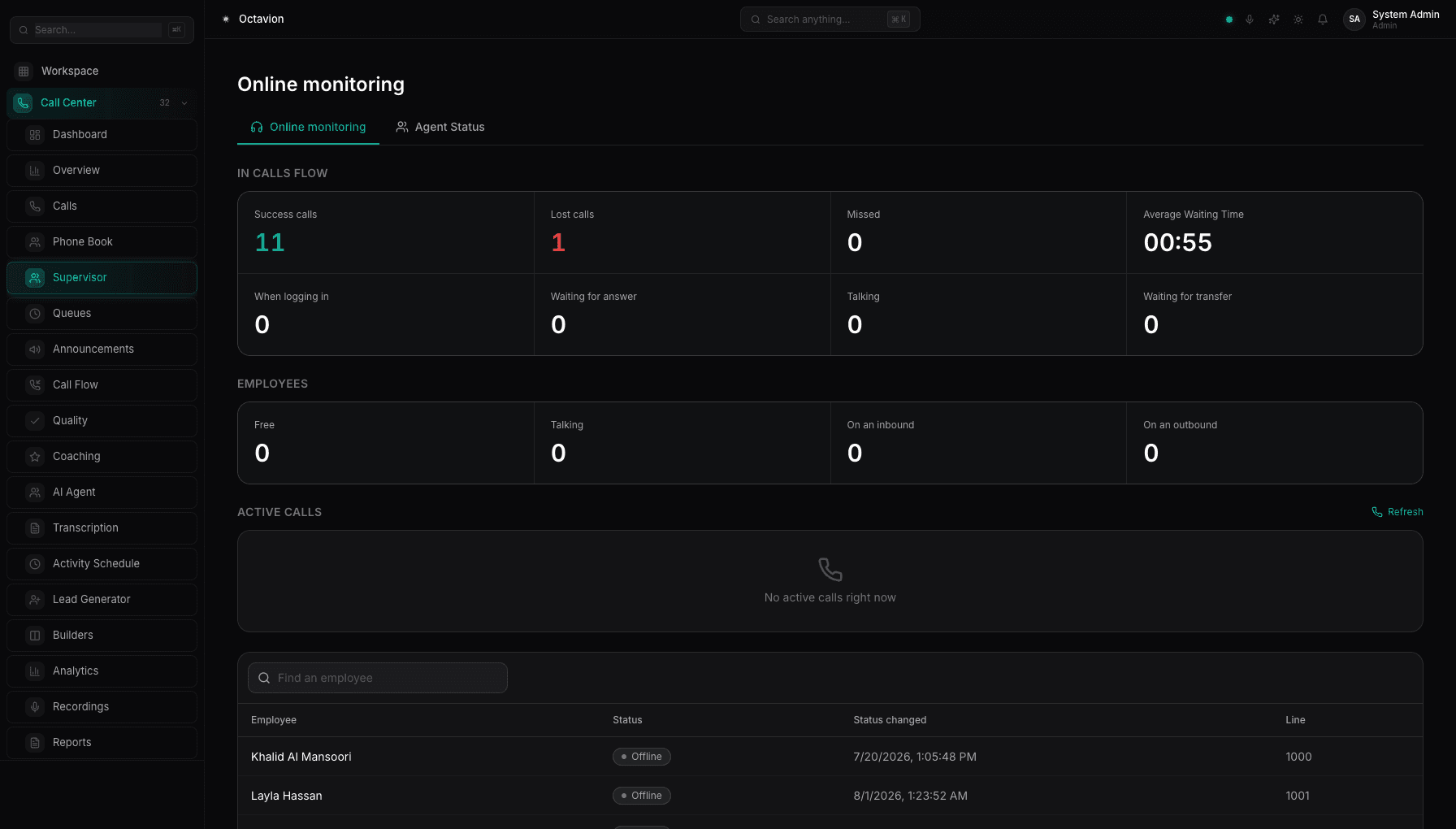
Coaching after the fact is slow. Coaching during the call is fast, and it needs three abilities: listen, so a supervisor hears a live conversation without either party knowing; whisper, so they can prompt the agent alone; and barge, so they can join a call heading for a lost customer.
Those three exist in serious telephony platforms and in almost no sales-tool add-ons. Check them in a trial with a real handset. Check the reverse case too: an agent should see their own calls and recordings, not the whole company's.
Alongside them you want a quality scorecard your team owns. The template matters less than owning it — a clinic scoring greeting, identity check and appointment confirmation has nothing in common with a logistics desk scoring quote accuracy. A scorecard you cannot edit becomes a ritual within a month; one you can edit becomes the agenda for a weekly fifteen-minute review, where the improvement comes from.
Sectors weight all of this differently, so it is worth seeing how the platform is set up for different industries before you design your own.
The numbers that tell you whether it is working
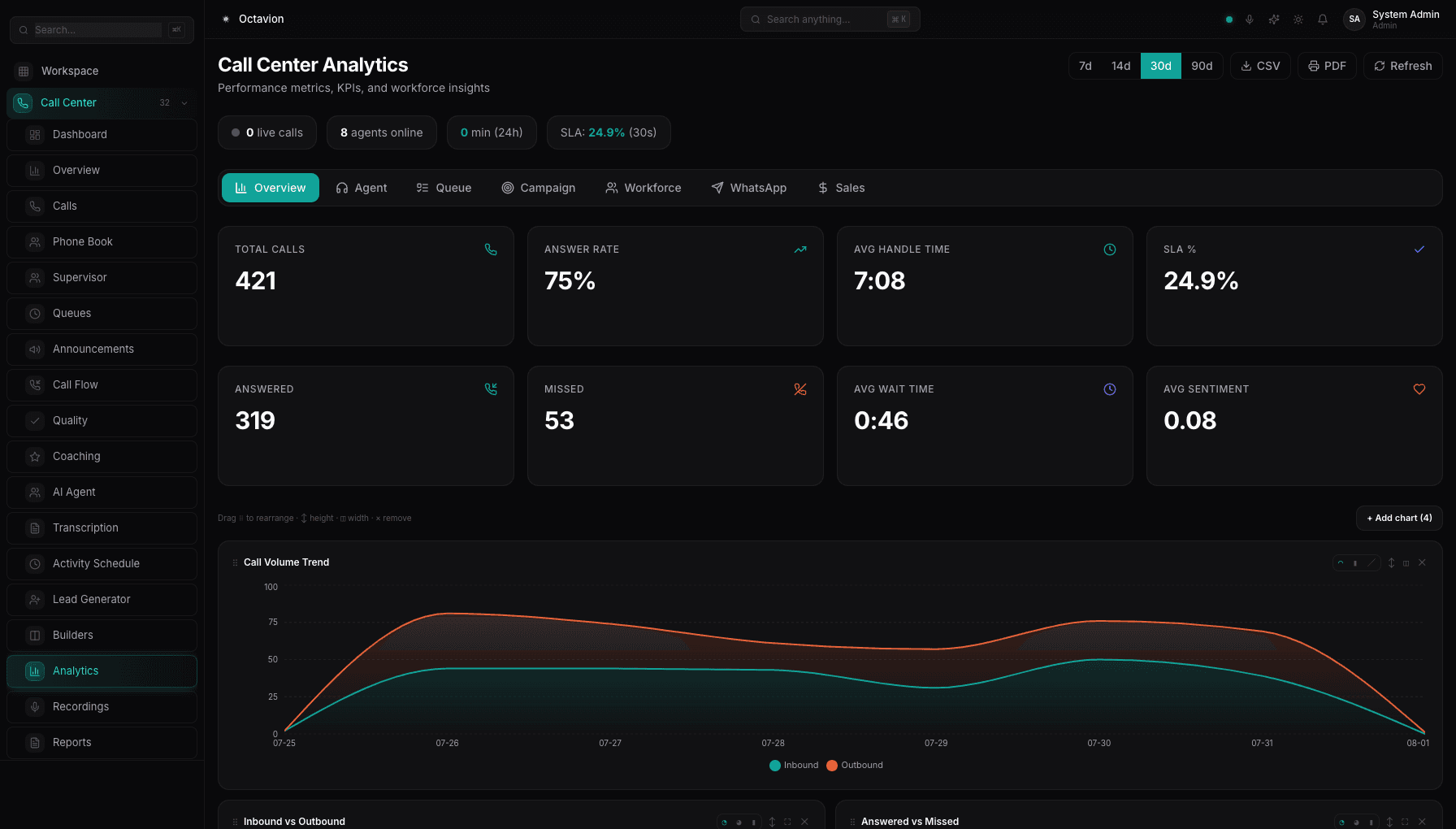
Four figures cover most of it: answer rate, average speed of answer, the share of calls answered inside your target window, and abandonment past a threshold you set. Sentiment is a useful fifth, as a way of finding the calls worth listening to rather than as a score in its own right.
The discipline that matters is interrogating the definitions before you trust the dashboard. Ask what counts as a missed call; an outbound attempt the operator rejected is not a customer you failed. Ask whether ringing time sits inside talk time, because if it does, your handling time is fiction. Ask whether an internal transfer counts as a second call, because if it does, your volume is inflated and your answer rate flattered.
We have found real defects in our own reporting by asking exactly those questions, and fixed them. Any vendor who cannot explain a metric's arithmetic is showing you a number they do not understand either.
One measure never appears on a dashboard: how many enquiries arrive by phone that should not. If people call because they cannot see an invoice or a delivery date, the fix is upstream, in accounting and invoicing with 5% UAE VAT built in rather than in the queue.
What to check before you sign
Run this list against every shortlisted product, in a trial, with your own number:
- Four callers, three agents — does the fourth wait in a queue, hear their position, and get offered a callback?
- Change your opening hours yourself, in five minutes, without contacting support.
- Place a real outbound call to a UAE mobile and confirm the caller ID your customer sees.
- Listen, whisper and barge on a live call from a supervisor account.
- Open a finished call: the recording, the transcript, the summary, and the customer record it attached to.
- Log in as an ordinary agent and confirm they see their own work and nothing wider.
- Ask who hosts it and how your account is separated from everyone else's.
On that last point, be clear about the model: this platform is hosted and operated by us, with every tenant kept separate. It is not something you install on a server in your own office and maintain yourself. If your IT policy requires that, you need a different conversation, not a longer demo.
If the purchase also replaces your finance system, the same discipline applies — what a VAT-ready ERP actually has to do in the UAE covers that side; the two decisions are easier taken together. For what sits alongside the phone system, the complete feature list across every module is the fastest route.
Then do the honest thing: try it before you commit. There is a 7-day trial you can start today, and no free tier behind it — after those seven days it is per seat, per month, priced in AED. A week is enough to answer four calls at once, break something, fix it yourself, and know whether the missed calls stop.