AI for small business in the UAE: what is real and what is still theatre
Every vendor in the region has an AI demo that works beautifully on a stage. This guide separates the parts that survive a real Tuesday in a Dubai office — transcription, quality scoring, a voice assistant wired into live records — from the parts that are still marketing. It also gives you a week-long test you can run yourself.
4 July 2026 · 8 min read
On this page
- 01The demo you were shown was not your business
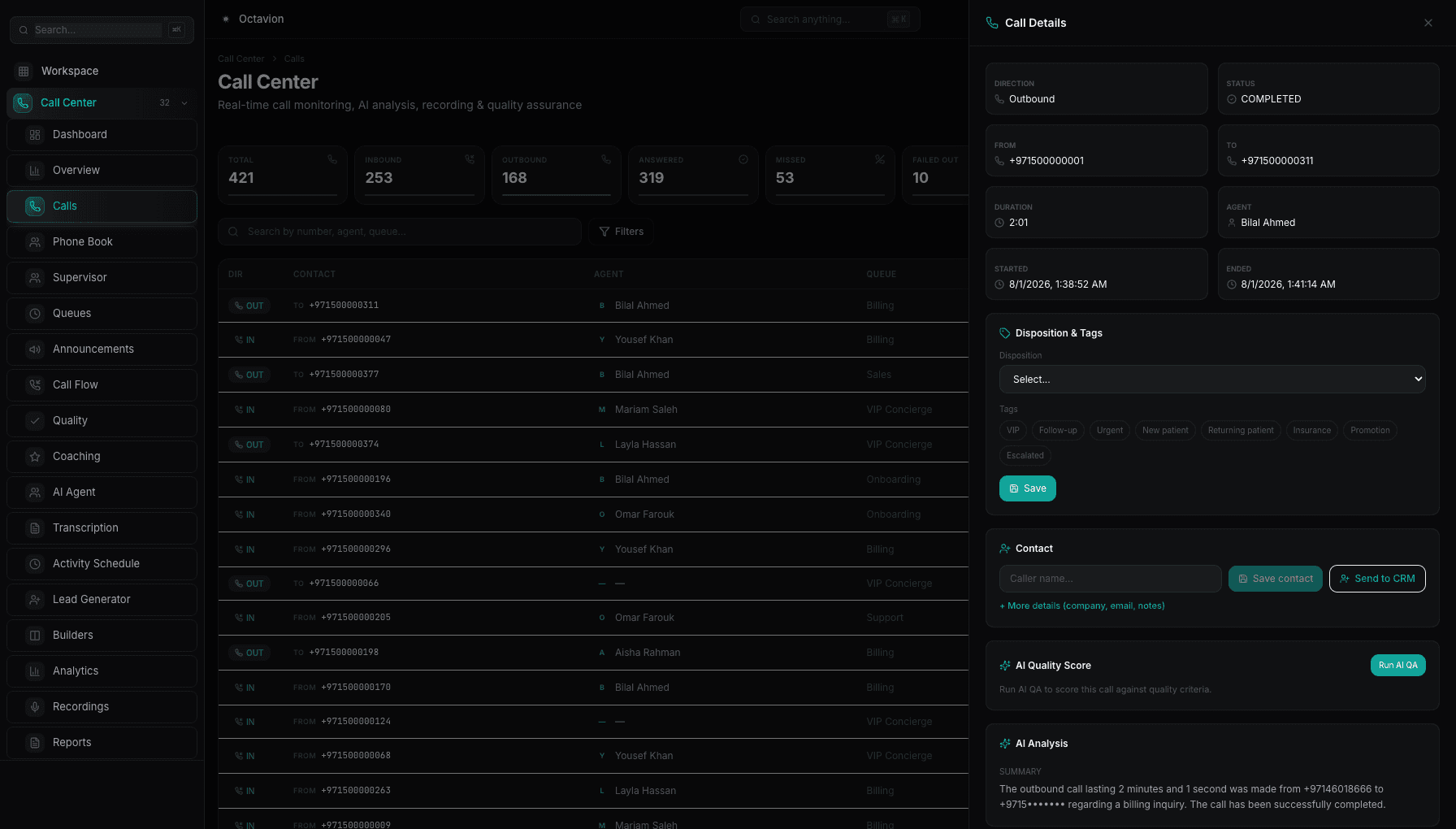
- 02Transcription and summaries: the part that pays for itself
- 03Quality scoring without listening to everything
- 04A voice assistant that reads your live numbers
- 05What is still theatre
- 06Where the AI sits in everything else you run
- 07How to test any AI claim in a week
- 08Start with one honest week
The demo you were shown was not your business
Picture a company of nine or ten people. Two answer the phone all day, one chases invoices, one runs the warehouse, and everyone else does a bit of everything. Someone forwards the owner a video of an assistant that books appointments and writes emails, and nothing in that video says whether it would survive a Tuesday afternoon in that office.
That is the honest starting position for most owners looking at AI for small business in the UAE. The underlying technology has genuinely improved. What has not improved is the distance between the demo and what the software does on day forty, when the caller switches between Arabic and English mid-sentence, the line is a mobile in a car park, and the customer's name is spelled four different ways in your records.
So this guide separates two things: what the software does today on real customer data, and what is still, politely, theatre.
Transcription and summaries: the part that pays for itself
Call recording is decades old and almost nobody listens to the recordings. That is the problem AI solves first. Not intelligence — readability.
Every call that passes through the call centre with its queues and recording is transcribed and given a short summary, a sentiment read and a suggested disposition. The recording still exists, but it is no longer the primary artefact. The text is. That single change turns a manager who could listen to a handful of calls a day into one who can scan a week of them and search every word said last month.
The wins are unglamorous and immediate. A customer disputes what was promised, and you find the sentence in seconds instead of scrubbing through the audio. A new salesperson keeps losing deals at the same point, and six of their transcripts show you exactly where. A complaint escalates, and the summary is already sitting on the customer's record in the CRM deals and leads pipeline, so whoever picks it up is not starting cold. Calls log themselves against the customer, so nobody has to remember to write the note — which is the step that actually fails in a busy office.
Now the honest limits. Arabic transcription in the Gulf is harder than English: dialect varies, people code-switch into English for product names, and phone audio throws away the frequencies that separate similar consonants. Accuracy is good enough to search, summarise and understand intent. It is not good enough to treat a transcribed number as a fact. Names, quantities and amounts are where errors cluster, which is exactly where an error costs money.
The working rule: use the transcript as an index and a pointer to evidence, never as the record itself. If a figure matters, it belongs on an invoice or a quote inside the accounting and inventory system, typed by a person who confirmed it.
Quality scoring without listening to everything
Most small firms review no calls at all — not from indifference, but because the arithmetic never works. Reviewing one call properly takes real, uninterrupted time, and doing that for every agent every week is a part-time job nobody has.
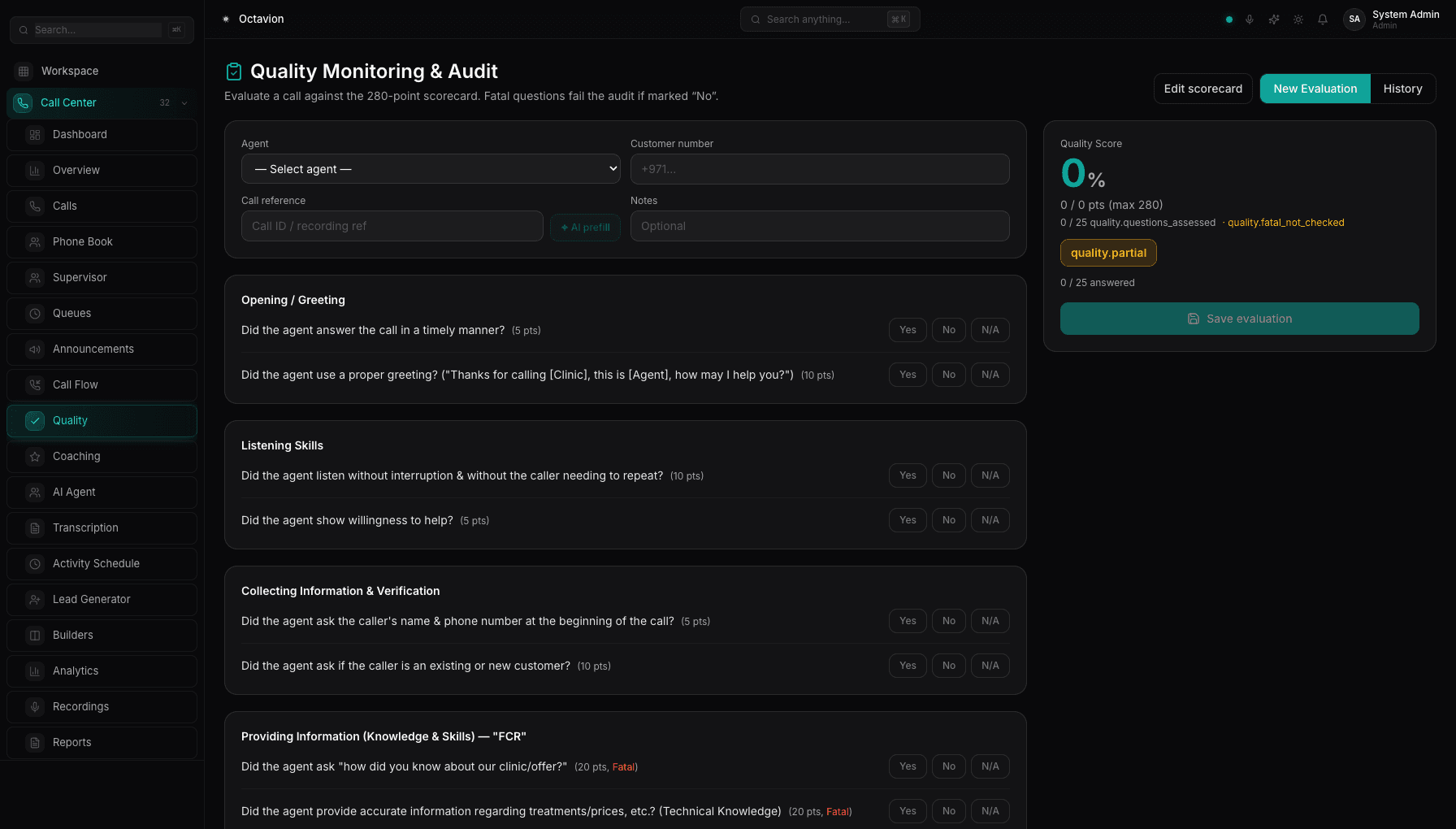
AI scoring changes the arithmetic. You define the scorecard once — greeting, needs discovery, the compliance line you are required to say, whether a next step was agreed, how the call closed. The model then evaluates every call against it and returns a score with the quoted moment that justifies each mark.
Two rules keep this from becoming theatre itself. First, a score with no citation is worthless: if it cannot show you the line where the agent failed to confirm the appointment, it guessed. Second, a human signs off on anything that affects someone's pay, bonus or record. The model triages, the supervisor decides. Anyone selling automated performance management with nobody in the loop is selling you a future grievance.
Scoring also sits next to ground truth you already collect: the CSAT survey a customer completes by pressing a key at the end of a call. A model's opinion and the customer's are different data; when they disagree consistently, the scorecard is wrong, and knowing that is worth more than the scores themselves. And a supervisor who can listen in, whisper a correction or join the call outright is still the fastest way to rescue a conversation that is going badly right now — no amount of after-the-fact scoring replaces being there.
A voice assistant that reads your live numbers
Here is the distinction that matters most. Some assistants are trained on a company's marketing text and answer questions about the company. Others are wired into its live records and answer questions about the business. The first is a chatbot. The second is useful.
The voice-first AI assistant is the second kind. Ask it in Arabic how much a particular customer owes and how old the balance is, and it reads the current receivables ageing rather than a cached figure from last night's export. Ask which deals have gone quiet this week and it reads the pipeline. Ask it to raise a quote, log a lead or open a support ticket, and it drafts the record for you to confirm.
Two design decisions make that safe to switch on. The assistant inherits the permissions of whoever is speaking to it, so a salesperson asking about payroll gets the same refusal they would get from the menu. And anything that writes to your data arrives as a draft a human confirms, because an assistant that mishears a quantity should produce a bad draft, not a bad delivery note.
Voice-first is not a gimmick here. Much of the working day happens with hands occupied: driving between sites, standing in a warehouse aisle, walking a clinic corridor between patients. Typing into a dashboard is not available in those moments. Asking out loud, in Arabic or English, is — which is why the clinic and patient records app gains more from it than head office does.
What is still theatre
Being specific about the failures is more useful than being enthusiastic about the wins. These are the claims worth pushing back on, whoever makes them:
- The autonomous agent that runs your operations. Models are strong at drafting, classifying and summarising, and unreliable across long chains of consequential steps: a small error at step two becomes a wrong purchase order at step seven with nobody watching.
- AI that closes sales end to end. It can qualify, log, remind and draft the follow-up. A person still closes, and in this region a person still built the relationship that made closing possible.
- Perfect transcription of every accent. Anyone quoting a single accuracy percentage for Gulf Arabic over mobile audio has not tested it on mobile audio.
- Forecasts with false precision. A revenue prediction carried to two decimal places out of twelve thin months of history is a guess wearing a suit.
- "AI-powered" features that are saved filters. If you cannot change the result by phrasing the request differently, no model is involved.
There is a quieter failure mode too: AI on top of a broken process. Summarising calls that should never have been inbound, or scoring agents nobody told what good looks like, produces articulate reports about a problem you already had.
Where the AI sits in everything else you run
The reason any of this works is that the data is in one place. Transcription is useful because the summary lands on a customer record; scoring is useful because calls, agents and queues are one system. The assistant can answer a question about receivables because the ledger is not stranded in a separate tool behind an integration that quietly broke in March.
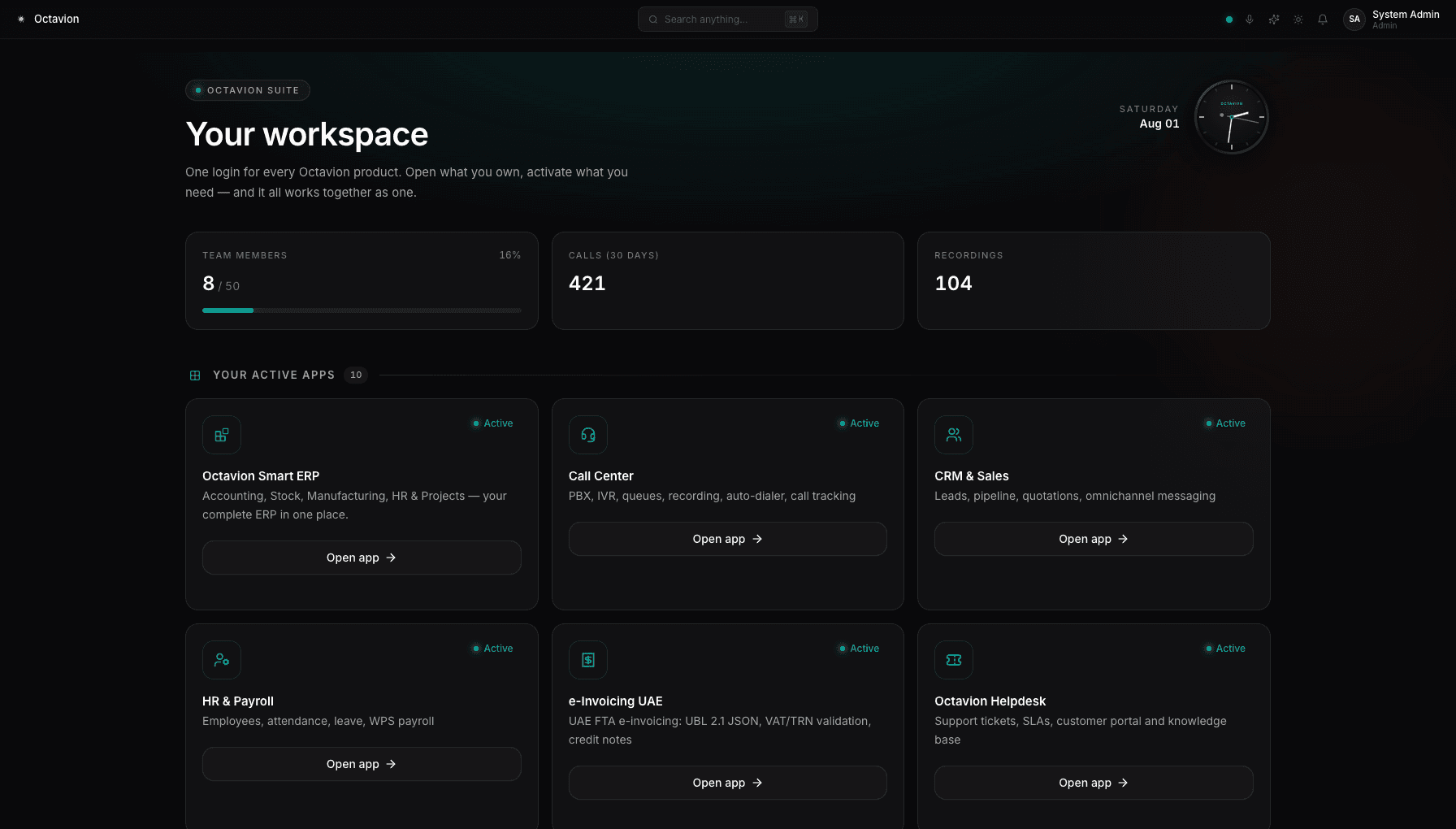
The same logic runs through the rest of the platform. Tickets in the helpdesk with SLA timers and a customer portal carry the same customer history. Conversations over WhatsApp on the official Meta Business Platform attach to the same timeline. Attendance and payroll in the WPS-ready HR and payroll app share the employee records the call centre already uses for agents. The full feature list maps what belongs where.
If you are choosing a finance system too, the companion guide on what a VAT-ready ERP has to handle in the UAE covers 5% VAT and AED invoicing properly. Read it before judging any AI feature that sits on accounting data: an assistant reading a badly configured ledger gives confident wrong answers, which are far harder to catch than obviously broken ones.
How to test any AI claim in a week
A trial is only informative if you treat it as an audit, not a tour. Seven days is enough, provided you spend them on real work rather than sample data.
- Run your ugliest calls through it. Not the clean ones. The mobile-in-traffic call, the fast dialect, the customer who talks over your agent. Read the transcript and mark every error.
- Ask the assistant something you already know. A total you checked yourself this morning. If it matches, ask something harder. If it does not, find out why before you trust anything else it says.
- Score a few calls by hand, then compare. Where you and the model disagree, decide who was right. That exercise usually improves your scorecard more than it improves the model.
- Hand it to your least technical colleague. Adoption dies with the person who quietly goes back to the old way, not with the enthusiast who ran the pilot.
Decide before you start what result would make you buy and what would make you walk away; deciding afterwards is how people talk themselves into software they later resent. Test the boring plumbing too: whether the Arabic interface reads naturally to the staff who will live in it, and whether whoever does your month-end close agrees the figures on screen.
Start with one honest week
None of this is magic and none of it replaces your team. Transcription settles disputes with evidence. Scoring makes coaching possible at a size where it was previously impossible. An assistant that reads live data answers the questions you would otherwise interrupt someone to ask. That is a real return, and a smaller claim than the one in the video you were sent.
Everything is sold per seat per month in AED, and the AI features come with the products rather than as a separate mystery line — the per-seat rates in AED set out what each one costs. The product documentation goes through the mechanics option by option if you want the detail first.
When you are ready to test rather than watch, start the 7-day trial and put a real week of your own calls and numbers through it. If it does not earn its place in seven days, it was never going to earn it in seventy.